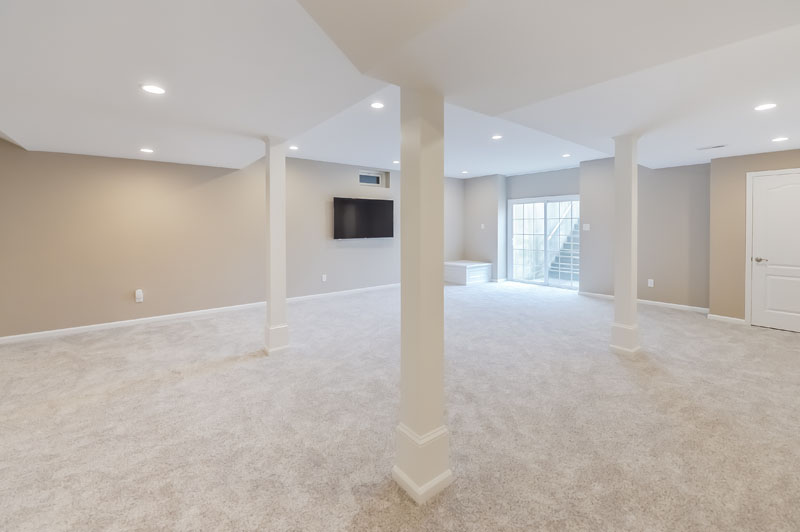
Modern Finished Basement Ideas: Getting Downstairs to the Details
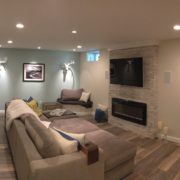
What is your idea of a modern finished basement? Don’t let other contractors sell you on the idea that laying a carpet down and installing some cheap drop ceiling panels qualify as “finished.” There is so much more that can be done to convert your basement into a real, honest-to-goodness, bona fide living space that you’ll wonder how you ever lived without it. But as with any successful home remodeling project, it’s all about attention to detail every step of the way.
Explore Basement Remodeling with Ayars
Framing basement walls
Once we have an idea of the design for your finished basement, how it will be laid out, and what features it will contain, we can move on to framing. We take great care in framing basement walls because we know the setup phase is critical to the execution.
When framing basement walls, we are trying to accomplish four main things:
- Structural integrity — To help achieve this, we use steel studs for their sturdy and resilient properties.
- Fireblocking — Limiting the amount of oxygen that can get into spaces between walls (and in between ceiling joists) in the event of fire.
- Waterproofing — Moisture is the mortal enemy of any basement, finished or unfinished. When there is evidence of water issues (such as cracks) along the outside walls, it’s important we reinforce and draw water away from those walls before framing and hanging drywall.
- Housing and hiding our mechanicals — It’s what’s on the inside of walls that counts, too. You’ll need wiring, plumbing, and HVAC routed correctly for your modern finished basement idea to become a reality. The less conspicuous we can make these elements, the more “finished” your basement will look and feel.
Modern finished basement ceiling ideas
Many of those same mechanicals we just talked about have to run through the ceiling, too. If you favor a more industrial or nautical look (like that of the cabin of an ocean liner), painting the overhead joists and beams may suffice.
Others may settle for the aforementioned drop ceilings, which is a gridded metal framework that hangs from the joists and is filled in with drop ceiling tiles. Although there are much better-looking options as far as those go than there used to be, most modern finished basements steer away from them.
At Ayars, dry-walled ceilings are our preferred method of finishing since it is more cohesively integrated with the rest of the home. This opens up opportunities for a polished look and feel with recessed lights, crown molding, and paint, just as you would see on upper floors.
Modern finished basement flooring ideas
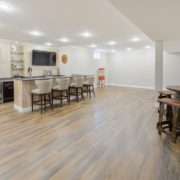
Whatever finished basement flooring idea you have in mind, a moisture-resistant material should be a top consideration — because raised humidity and flood risk just come with the underground territory. Thankfully, basement flooring material options are numerous and varied. Here are some of our favorites:
- Luxury vinyl tile/plank: A major upgrade over conventional sheet or tile vinyl flooring on account of its thickness, durability, and impressive emulation of real wood and stone.
- Engineered wood: Engineered wood is less apt to warp in damper environments than solid hardwood and is virtually indistinguishable.
- Ceramic/porcelain tile: Naturally wear-resistant and water-repellant, ceramic or porcelain tiles are one of the best options for the long term. You may want to consider an anti-slip finish for condensation and/or radiant heating to keep things warm underfoot.
- Plank (“wood-look”) tile flooring: Plank tile flooring combines the durable qualities of ceramic/porcelain tiles with the timeless look of wood. Because of their rectified (90-degree) edges, they fit together nearly seamlessly with nearly invisible grout lines.
Modern finished basement storage ideas
Many people conceptualize basement storage as tossing whatever it may be down the stairs into a dark abyss, never to be seen again. With finished basement storage, however, we’ll want to be more intentional and organized. And for a modern finished basement, we’ll want to be clever and creative, too. Here are some examples of the bespoke storage solutions we’ve drawn up for our clients:
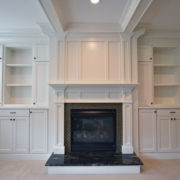
- Built-in drawers and cubbies
- Under-stairs closet
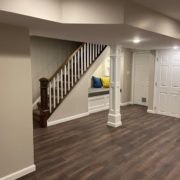
- Under-stairs reading nook with bench storage
- Equipment storage area in foundation jut-out
Finish your basement the right way with Ayars
The best modern finished basement ideas begin and end with the details. Don’t miss a step on your way down to your favorite new living area; discuss your dream with the Ayars team today.
Modern Finished Basements
A modern basement moves beyond the old standard of simply laying down carpet and installing cheap drop ceiling panels. Instead, it focuses on converting the area into a “bona fide living space” that feels just as finished as the rest of your home. This is achieved through strict attention to detail regarding framing, ceilings, and flooring.
Not necessarily. While mechanicals often run through the ceiling, you have better options than traditional grid-and-tile drop ceilings, which most modern designs avoid.
- Drywall: This is the preferred method for a modern look because it integrates cohesively with the upper floors of your home. It allows for polished details like crown molding and recessed lighting.
- Industrial Style: For a nautical or industrial aesthetic, you can simply paint the exposed overhead joists and beams.
Moisture resistance should be your top priority due to the risk of humidity and flooding underground. The blog suggests three modern favorites:
- Luxury Vinyl Tile/Plank: This offers a major upgrade over old vinyl, providing durability and impressive emulation of real wood or stone.
- Ceramic/Porcelain Tile: These are naturally water-repellent and wear-resistant. You can also choose “wood-look” plank tiles with rectified edges for seamless grout lines.
- Engineered Wood: This is virtually indistinguishable from solid hardwood but is less likely to warp in damp environments.
Framing is the setup phase that is critical to the final execution. A professional framing job accomplishes four specific goals:
- Structural Integrity: Using steel studs ensures the walls are sturdy and resilient.
- Hiding Mechanicals: Proper framing inconspicuously hides wiring, plumbing, and HVAC systems.
- Fireblocking: It limits oxygen flow between walls and joists in the event of a fire.
- Waterproofing: It involves reinforcing walls and drawing water away before drywall is hung.
A modern basement requires intentional and organized storage rather than serving as a dark abyss for clutter. You can utilize bespoke solutions that hide clutter while looking stylish, such as:
- Built-in cubbies and drawers.
- Closets or reading nooks with bench storage tucked under the stairs.
- Dedicated equipment storage areas located in foundation jut-outs.